
Ultrasonic homogenizers are versatile tools widely used in various applications, including nanoparticle creation, emulsification, particle size reduction, and cell lysis. However, when processing substances intended for human consumption, one critical concern arises: the potential migration of trace amounts of titanium alloy from the probe into the sample. This article explores the implications of titanium migration, methods to mitigate risks, and alternative solutions for safe processing.
Understanding Titanium Migration in Ultrasonic Homogenization
Ultrasonic homogenizer probes are typically made of a titanium alloy, Ti-6Al-4V. During the homogenization process, the probe vibrates rapidly, causing microscopic erosion of the probe material. This erosion can lead to the migration of trace amounts of titanium and aluminum into the sample. While titanium is generally considered biocompatible and is used in medical implants and toothpaste, there is evidence suggesting that titanium and its by-products could pose health risks when ingested.
Several studies have documented the presence of titanium in samples post-sonication. For example, a report by the National Institute of Standards and Technology (NIST) highlights that tip erosion is an unavoidable side effect of direct sonication, releasing microscopic titanium residues into the suspension. The extent of migration depends on factors such as processing time, amplitude, and the wear condition of the probe.
Methods to Remove Titanium from Processed Products
For substances intended for human consumption, it is crucial to minimize or eliminate titanium contamination. Two effective methods for removing titanium particles from samples are filtration and centrifugation. Filtration using sterilizing-grade filters (0.2 or 0.45 micron pore size) can effectively remove titanium particles, which are typically 0.5 microns or larger. Centrifugation is another option, as it concentrates the particles at the bottom of the vessel, allowing for easy separation.
These methods are particularly useful for applications where even trace amounts of titanium could compromise product safety. However, it is essential to consider the specific requirements of your process and the nature of the sample when choosing a removal method.
Limiting Titanium Migration During Homogenization
To reduce the risk of titanium migration, it is essential to optimize the homogenization process. Limiting processing time and using a unit with lower amplitude can help minimize erosion. However, these adjustments must be balanced against the desired outcome of the process, as they may affect the efficiency of homogenization.
Another critical factor is the wear condition of the probe. Regularly inspecting the probe for signs of erosion, such as a matte or pitted appearance, can help identify when replacement is necessary. In some cases, minor erosion can be addressed by buffing the probe with carbide paper or an emery cloth. However, for applications involving human consumption, it is advisable to replace the probe at the first sign of wear.
Alternative Solutions: High Pressure Homogenizers
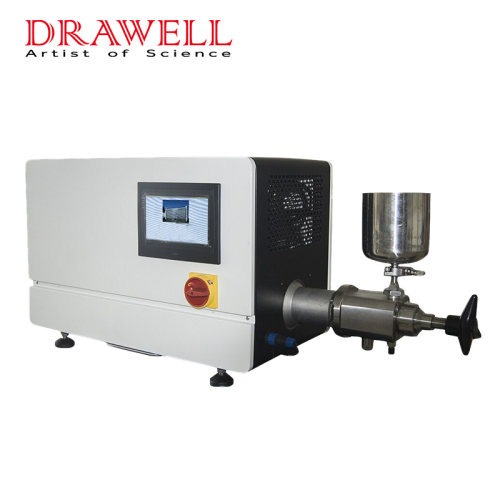
For applications where titanium contamination is a significant concern, alternative homogenization methods such as high pressure homogenizers can be considered. These systems use high-pressure pumps and valves to achieve particle size reduction and emulsification without the use of vibrating probes. This eliminates the risk of titanium migration, making them a safer option for processing substances intended for human consumption.
High pressure homogenizers are also highly efficient and versatile, suitable for a wide range of applications in the food, pharmaceutical, and cosmetic industries. For reliable equipment, consider exploring products from Drawell Analytical, a trusted provider of high-quality homogenizers and laboratory equipment.
Video Demonstration
In the video above, you can see a demonstration of how ultrasonic homogenizers work and the potential risks of titanium migration. The video highlights the importance of proper maintenance and alternative solutions for safe processing.
Ultrasonic homogenizers are powerful tools for processing substances, but their use in applications involving human consumption requires careful consideration of titanium migration risks. By implementing methods to remove titanium particles, optimizing the homogenization process, and exploring alternative solutions such as high pressure homogenizers, you can ensure the safety and quality of your products. Proper maintenance and equipment selection are key to achieving consistent and reliable results in your processing applications.